Best Filament Dryer for 3D Printing in 2026
Wet filament ruins prints. These are the best filament dryers for beginners, from a $45 budget box to the AMS-user default, ranked on real drying data.
Updated · We may earn a commission from links on this page. How that works
Our top picks
 Check price on Amazon
Best budget
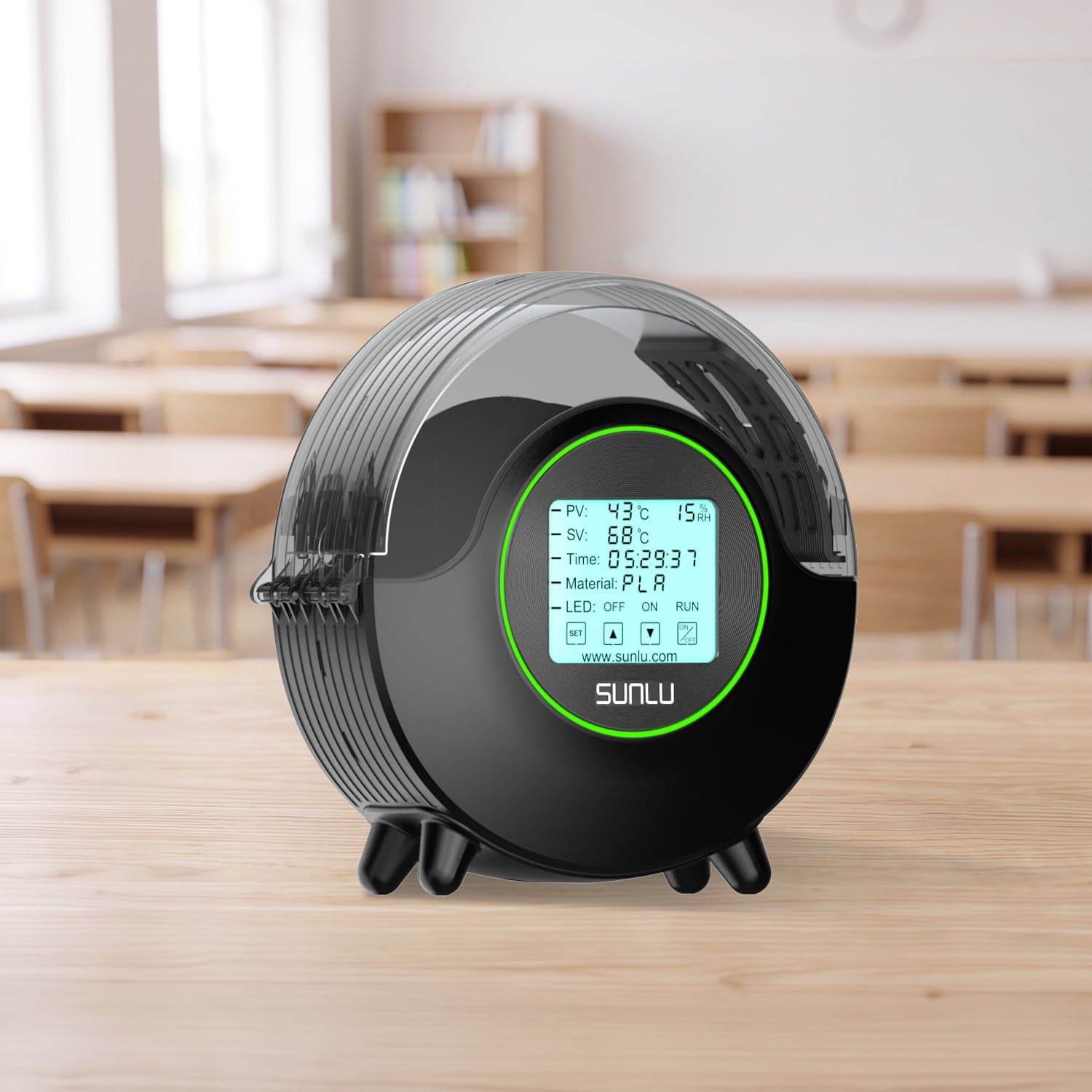
SUNLU S2 Filament DryerThe budget pick that actually dries. It's slower than the big units, but a full cycle gets the job done at half the price.
 Check price on SUNLU
Best for AMS users
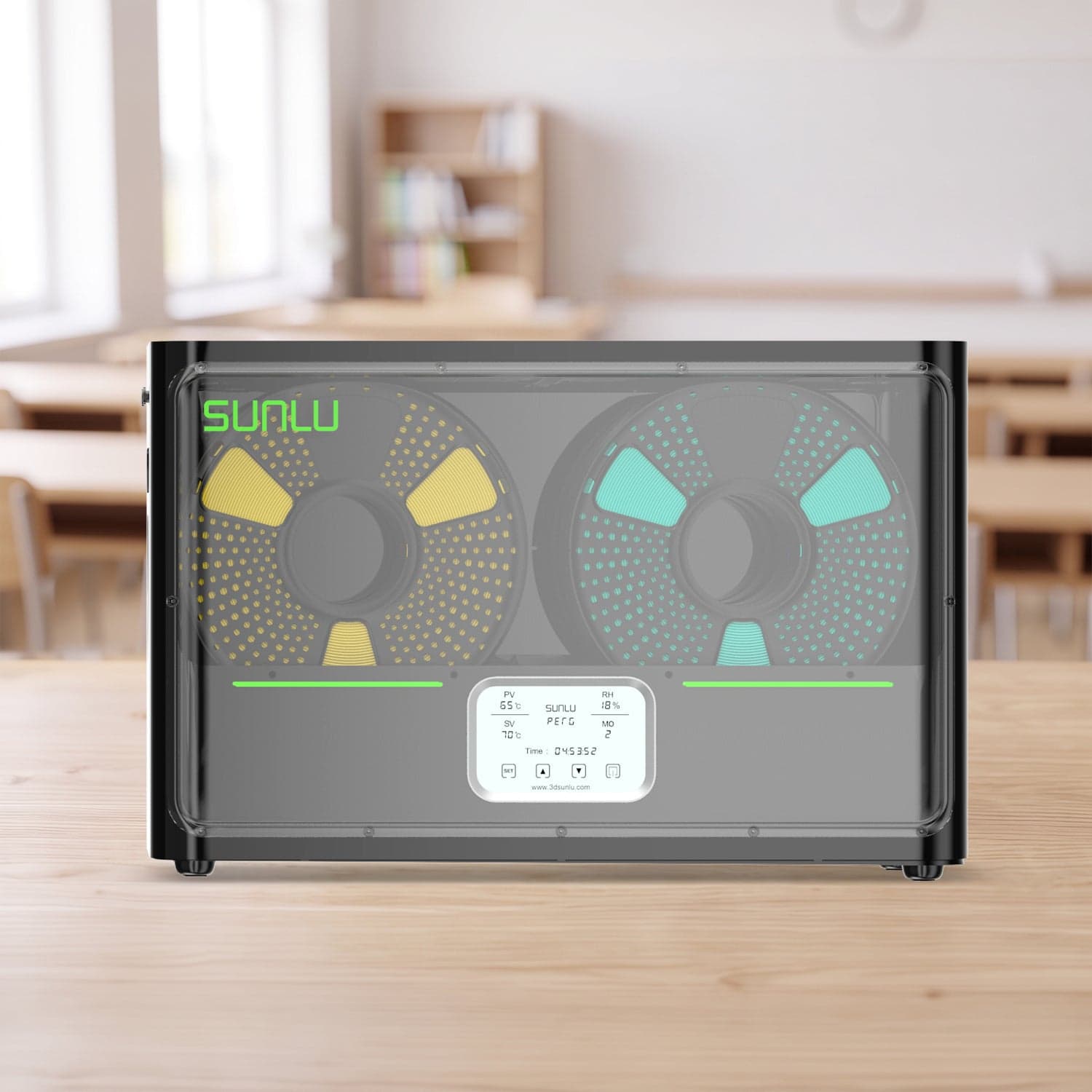
SUNLU FilaDryer S4The default choice if you own an AMS. It dries in batches, feeds printers directly, and tops the measured performance charts.
 Check price on EIBOS
Best set-and-forget
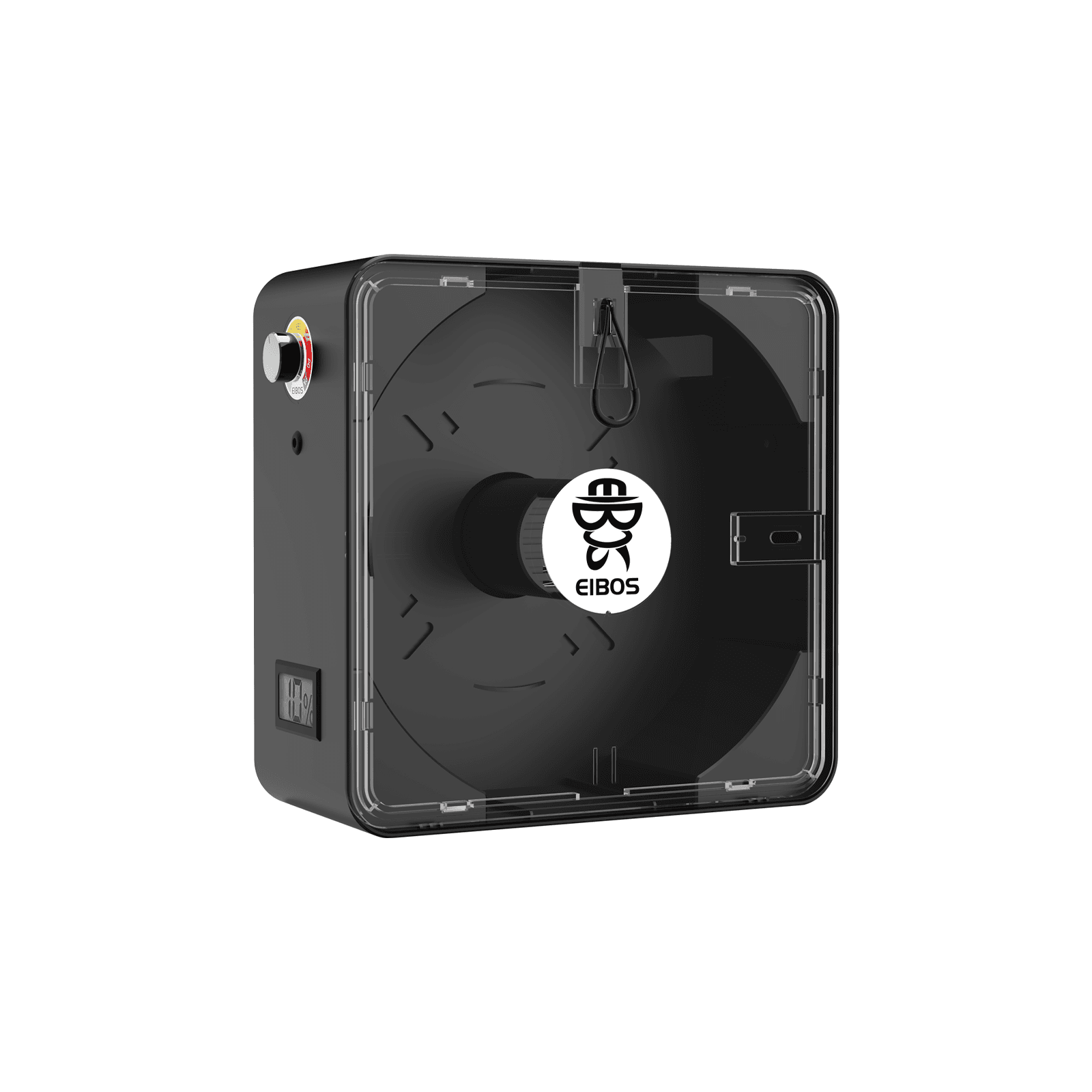
EIBOS EasDryA thoughtful single-spool dryer that doubles as a dry box. Check your voltage before buying outside the US.
Best dual-spool budget
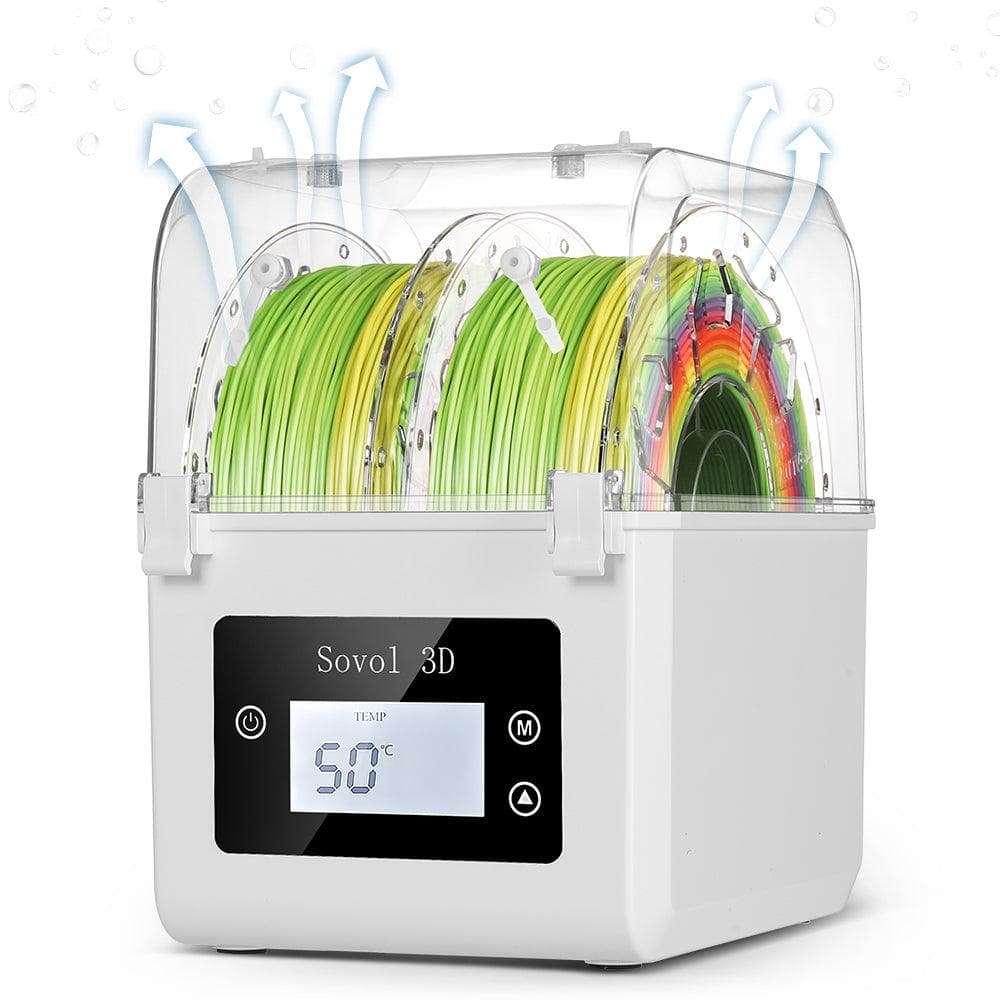
Sovol SH01Double the S2's capacity at the same price, as long as 50°C covers your materials. For PLA/PETG, it does.
 Check price on Comgrow
Best touchscreen dual-spool
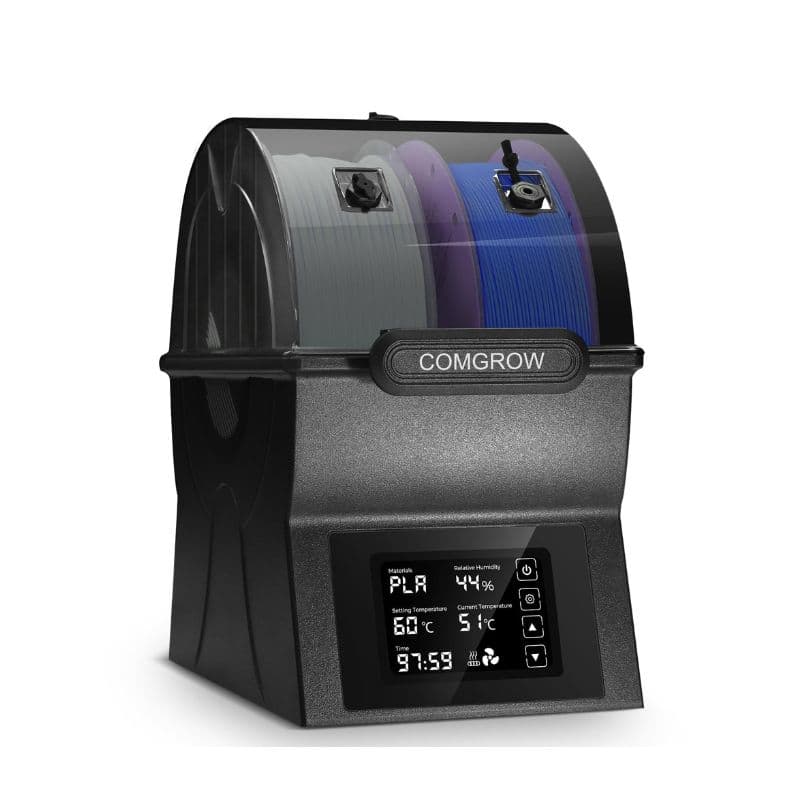
Comgrow SH02 Filament DryerThe dual-spool sweet spot: touchscreen convenience and ABS-capable heat without jumping to the S4's price.
If your prints suddenly start stringing, popping, or coming out with a rough, pitted surface, and nothing in your slicer settings changed, the filament itself probably isn't the problem. The moisture in it is.
Why wet filament ruins prints
Most 3D printing filament is hygroscopic: it absorbs water from the air, and some types do it within hours. PLA gets brittle and snaps. PETG strings and blobs. TPU and nylon are the worst; nylon can go from fresh to unprintable in a single humid day.
When wet filament hits the hotend, the trapped water flashes to steam, and you hear faint popping during extrusion. The steam leaves micro-bubbles in the extruded plastic, which causes rough surfaces, weak layer adhesion, and inconsistent extrusion. Drying the spool drives the moisture back out, and in most cases fully restores the filament. In a humid climate, a dryer isn't an accessory for perfectionists. It decides whether you can use your filament or have to throw it away.
One distinction matters for this guide. A dryer actively heats filament to drive moisture out. A dry box is just sealed storage that keeps dry filament dry. We cover dry boxes briefly at the end, but they can't rescue a spool that's already wet.
Our top picks at a glance
| Product | Price | Max temp | Capacity | Best for |
|---|---|---|---|---|
| SUNLU S2 Filament DryerCheck price | ~$45 | 70°C | 1 spool | Budget single-spool drying |
| SUNLU FilaDryer S4Check price | ~$117 | 70°C | 4 spools | AMS / multi-printer owners |
| EIBOS EasDryCheck price | ~$55 | 65°C | 1 spool | Set-and-forget drying + storage |
| Sovol SH01 | ~$45 | 50°C | 2 spools | Dual-spool on a budget |
| Comgrow SH02 Filament DryerCheck price | ~$59 | 70°C | 2 spools | Touchscreen dual-spool |
Prices verified October 2026. They move with sales, so check the live price before buying.
Best budget pick: SUNLU FilaDryer S2
The S2 is the dryer we'd hand to a beginner with one printer and a tight budget. It heats to 70°C with 360° surround heating and a circulation fan, fits one 1 kg spool, and lets you print straight from the box through a PTFE tube while it dries. One-touch presets cover the common materials, and the touchscreen is straightforward. At ~$45 (verified October 2026), it's the cheapest credible way to actually dry filament rather than just store it.
In the 1-hour moisture-removal test, the S2 removed 48.8% of moisture. That's the slowest of the fast dryers here, roughly half what the S4-class machines manage. Slower isn't the same as bad, though: give it a full 6-hour cycle and it handles even water-soaked PLA fine. Its built-in humidity readout is known to be inaccurate, so treat it as a rough indicator, not a measurement.
Best for: one printer, PLA/PETG/TPU, and anyone who wants drying solved for the price of two spools of filament.
Image: SUNLUSUNLU S2 Filament Dryer
The budget pick that actually dries. It's slower than the big units, but a full cycle gets the job done at half the price.
Good stuff
- Cheapest credible dryer at ~$45
- True 70°C for PLA/PETG/TPU
- Even 360° heating with fan
- Print-while-drying via PTFE tube
Watch out for
- Single spool only
- Slower than bigger dryers (48.8% in 1-hr test)
- Humidity sensor reads inaccurately
Best for AMS and multi-printer owners: SUNLU FilaDryer S4
If you run a Bambu AMS, or more than one printer, drying one spool at a time becomes a bottleneck. The S4 holds four 1 kg spools with eight filament outlets, so you can feed four printers or four AMS slots straight from the dryer. It uses a 300 to 330W PTC heater with triple-fan circulation, holds ±3°C, and has a smart humidity mode that restarts drying automatically when moisture creeps back up. It costs ~$117 on SUNLU's official US store (verified October 2026; ~$130 on Amazon).
It's also the performance leader. It was best in test in the 1-hour moisture-removal comparison, clearing 100%+ where the single-spool units managed half that. Independent testing noted particularly strong TPU results, which makes sense, since TPU is one of the thirstiest common filaments.
The trade-offs are physical and practical. It's a big box with a big footprint, and the shared chamber means you can't dry PLA at 45°C and nylon at 70°C at the same time; all four spools get the same temperature. If you run same-material batches, that doesn't matter.
Best for: AMS owners, multi-printer setups, and anyone drying in batches rather than one spool at a time.
Image: SUNLUSUNLU FilaDryer S4
The default choice if you own an AMS. It dries in batches, feeds printers directly, and tops the measured performance charts.
Good stuff
- 4 spools at once, 8 filament outlets
- Best 1-hr drying performance in testing
- Auto-restart on humidity rise
- Feeds AMS slots directly
Watch out for
- Large footprint
- One temperature for all four spools
- ~$117, 2.5× the budget picks
Best set-and-forget single spool: EIBOS EasDry
The EasDry takes a different approach to drying a single spool. A stepless temperature knob (40 to 65°C) lets you set the heat per material, and two desiccant bays let the box double as sealed storage between drying sessions. It has 45W hot-air circulation, a humidity LCD, print-while-drying, and a measured noise level of 38.5 dB, quiet enough to forget it's running. It costs ~$55 (verified October 2026).
In the 1-hour test it landed mid-pack at 91.1% moisture removal, nearly double the S2's pace and behind only the S4-class machines. The knob is genuinely useful: you dial 45°C for PLA or 60°C for PETG instead of scrolling through presets. Two caveats. It's US plug only (110 to 120V), so international buyers need to check their voltage. And its measured max temperature came in at 57°C against the 65°C claim. That's fine for PLA/PETG/TPU, but it was never a nylon machine anyway.
Best for: beginners who want to set a temperature, walk away, and leave the spool sealed in the box afterward.
Image: EIBOSEIBOS EasDry
A thoughtful single-spool dryer that doubles as a dry box. Check your voltage before buying outside the US.
Good stuff
- Stepless knob: dial exact temps per material
- Desiccant bays for storage mode
- Quiet at 38.5 dB measured
- Strong mid-pack drying (91.1% in 1-hr test)
Watch out for
- US plug only (110 to 120V)
- Measured 57°C max vs 65°C claimed
- Single spool
Best dual-spool on a budget: Sovol SH01
The SH01 gets you two spools for the price of one budget dryer. It holds 2 × 1 kg spools (or one wide spool up to 150 mm) and has a temperature and humidity display, smooth rollers, desiccant compartments, and a power-off mode that keeps drying on stored heat. At ~$45 (verified October 2026), it costs about the same as the S2 with double the capacity.
The catch is the ceiling: three fixed presets at 40, 45, and 50°C, and nothing higher. (Some listings confuse it with other Sovol models and claim 70°C; the official spec is 50°C max.) That's plenty for maintenance drying of PLA and PETG, and testing shows it pulls relative humidity from 30% to under 20% in about 8 hours. It's not an ABS or nylon dryer. Desiccants aren't included, and fan noise reports conflict (some owners call it quiet, others don't), so expect noise to vary by unit.
Best for: budget dual-spool drying and storage where 50°C covers your materials, which it does for PLA/PETG beginners.
Image: SovolSovol SH01
Double the S2's capacity at the same price, as long as 50°C covers your materials. For PLA/PETG, it does.
Good stuff
- 2 spools for ~$45
- Effective moisture removal at its temps
- Smooth rollers, sealed design
- Power-off drying mode
Watch out for
- 50°C max: no ABS/nylon
- Desiccants not included
- Conflicting fan-noise reports
- No quick-access front opening
Best touchscreen dual-spool: Comgrow SH02
The SH02 is Comgrow's current dual-spool dryer, and it lifts the SH01's 50°C ceiling. It reaches 40 to 70°C from a 150W PTC heater with 360° air circulation, and it has a proper touchscreen with one-key presets for nine filament types. The 70°C ceiling is what matters, because it opens up ABS and ASA, which the 50°C boxes can't handle. It holds two 1 kg spools, seals with multiple rings, has a 98-hour max timer, and supports print-while-drying through its filament outlets.
It costs ~$59 on Comgrow's official store (verified October 2026), roughly $15 more than the SH01 for the touchscreen, the extra 20°C, and the faster heater. You're paying for temperature headroom and convenience, not record drying speed. It's still not a nylon machine (70°C falls short of the 80°C+ that PA and PC want), and at this price the SUNLU S4's four-spool capacity starts to look tempting if you run more than one printer.
Best for: dual-spool drying with ABS or ASA in the mix, and anyone who'd rather tap a preset than click through menus.
Image: ComgrowComgrow SH02 Filament Dryer
The dual-spool sweet spot: touchscreen convenience and ABS-capable heat without jumping to the S4's price.
Good stuff
- 70°C max: handles ABS/ASA
- Touchscreen with 9 one-key presets
- 150W PTC heats fast (50°C in ~7 min)
- Dual-spool, well sealed
Watch out for
- ~$59, about $15 more than the SH01
- Not nylon-grade (70°C < 80°C)
- Bulkier than the SH01
How we picked
- Real drying performance. An independent 1-hour moisture-removal test (mytechfun) gives a like-for-like dataset across the major dryers, so the rankings here rest on measured results, not marketing wattage.
- Max temperature vs. material needs. PLA and PETG dry happily at 45 to 65°C, ABS wants ~60°C, and nylon and polycarbonate need 80°C+. A dryer's ceiling decides which materials it's actually useful for.
- Capacity and workflow. Single-spool vs. multi-spool, and whether you can print directly from the dryer while it runs (print-while-drying keeps filament dry during long jobs).
- Honest trade-offs. Humidity sensors on budget dryers are often inaccurate, shared chambers can't run two temperatures at once, and some "70°C" claims don't survive measurement. We've noted those caveats in each pick.
What about dry boxes?
A dry box is sealed storage, not a dryer. It keeps dry filament dry but won't rescue a wet spool. Two are worth knowing:
- eSUN eBox / eBox Lite (~$35 to $70): the common entry-level dry box. It's fine as passive storage for spools that are already dry. Some versions add gentle heat, but don't buy one expecting it to dry a soaked spool.
- Polymaker PolyDryer: a modular dry-storage system aimed at multi-spool setups. We couldn't verify street pricing at research time, so compare live prices before considering it.
For most beginners, the practical setup is one active dryer (S2 or EasDry) for rescuing and pre-drying spools, plus sealed storage for everything else, whether that's dry boxes or just sealed bags with desiccant. You don't need a dry box per spool on day one.
Buying advice
Match the temperature to your materials. For PLA and PETG, 45 to 65°C covers you, so any pick here works. For ABS/ASA you want a true 60 to 65°C: the S2, S4, and SH02 get there, but the SH01, with its 50°C ceiling, doesn't. Nylon and PC need 80°C+, which none of these reach. That's specialist territory (PrintDry's PRO4 is the current high-temp option if you go there).
Don't trust the humidity display. Sensors on budget dryers are consistently inaccurate across brands. Use the display to watch the trend (is the number going down?) and judge results by print quality. The popping test never lies.
Dry new filament too. Spools often arrive damp from the factory, especially in humid months. Running a 4 to 6 hour cycle on every new spool of PETG, TPU, or nylon before first use prevents a whole category of mysterious first-print failures.
One dryer or two? Start with one. A single-spool dryer plus sealed bag storage can handle a one-printer setup indefinitely. Add a second dryer (or step up to the S4) once you're regularly waiting on drying instead of printing.
Our picks, recapped
- Check price on Amazon
Best budget
SUNLU S2 Filament DryerThe budget pick that actually dries. It's slower than the big units, but a full cycle gets the job done at half the price.
- Check price on SUNLU
Best for AMS users
SUNLU FilaDryer S4The default choice if you own an AMS. It dries in batches, feeds printers directly, and tops the measured performance charts.
- Check price on EIBOS
Best set-and-forget
EIBOS EasDryA thoughtful single-spool dryer that doubles as a dry box. Check your voltage before buying outside the US.
Best dual-spool budget
Sovol SH01Double the S2's capacity at the same price, as long as 50°C covers your materials. For PLA/PETG, it does.
- Check price on Comgrow
Best touchscreen dual-spool
Comgrow SH02 Filament DryerThe dual-spool sweet spot: touchscreen convenience and ABS-capable heat without jumping to the S4's price.
FAQ
How do I know if my filament is wet?
Listen for faint popping or hissing during extrusion, and look for stringing, rough surfaces, or brittle filament that snaps when bent. If print quality dropped without any settings change, moisture is the prime suspect.
Can I dry filament in my oven instead?
Technically yes, but it's risky. Most ovens can't hold a stable 50 to 65°C and overshoot easily, which can fuse the spool or degrade the filament. A $45 dryer is cheaper than a ruined spool and a smoky kitchen.
How long does it take to dry a spool?
A moderately damp PLA or PETG spool typically needs 4 to 6 hours at 55 to 65°C. Soaked nylon can need 12 to 24+ hours at 80°C. The 1-hour test figures in this guide compare relative speed, not full drying times.
Do I need a dryer if I only print PLA?
In a humid climate, yes. PLA absorbs moisture and gets brittle. In a dry climate with sealed storage and desiccant, you can get away without one. If your PLA snaps when you bend it, you needed a dryer yesterday.
Dryer vs dry box: which should I buy first?
The dryer. A dry box only preserves filament that's already dry, while a dryer both rescues wet spools and keeps filament dry during printing. Add dry boxes later for cheap bulk storage.
Can I print while the filament is drying?
Yes, on every pick in this guide. They all support print-while-drying by feeding filament out through a tube or outlet while the heater runs, which is the best way to keep filament dry during long prints.
Prices verified October 2026. They move with sales, so check the live price before buying. As an affiliate site, we may earn a commission on purchases made through our links, at no extra cost to you. Read our affiliate disclosure.
Related guides
- Buying guideBest 3D Printer for Cosplay in 2026Large-format 3D printers for cosplay helmets and armor, ranked by build volume and long-print reliability — plus a small-prop specialist for detail work.
- Buying guideBest 3D Printer for Miniatures in 2026Resin 3D printers ranked for tabletop miniature detail: pixel size, tilt-release vats, and first-print success — plus the ventilation rules.
- Buying guideBest 3D Printer for Small Business in 2026The most reliable 3D printers for prototypes, custom products, and short-run manufacturing — ranked for uptime and total cost.